
Map of Baffin Mountains
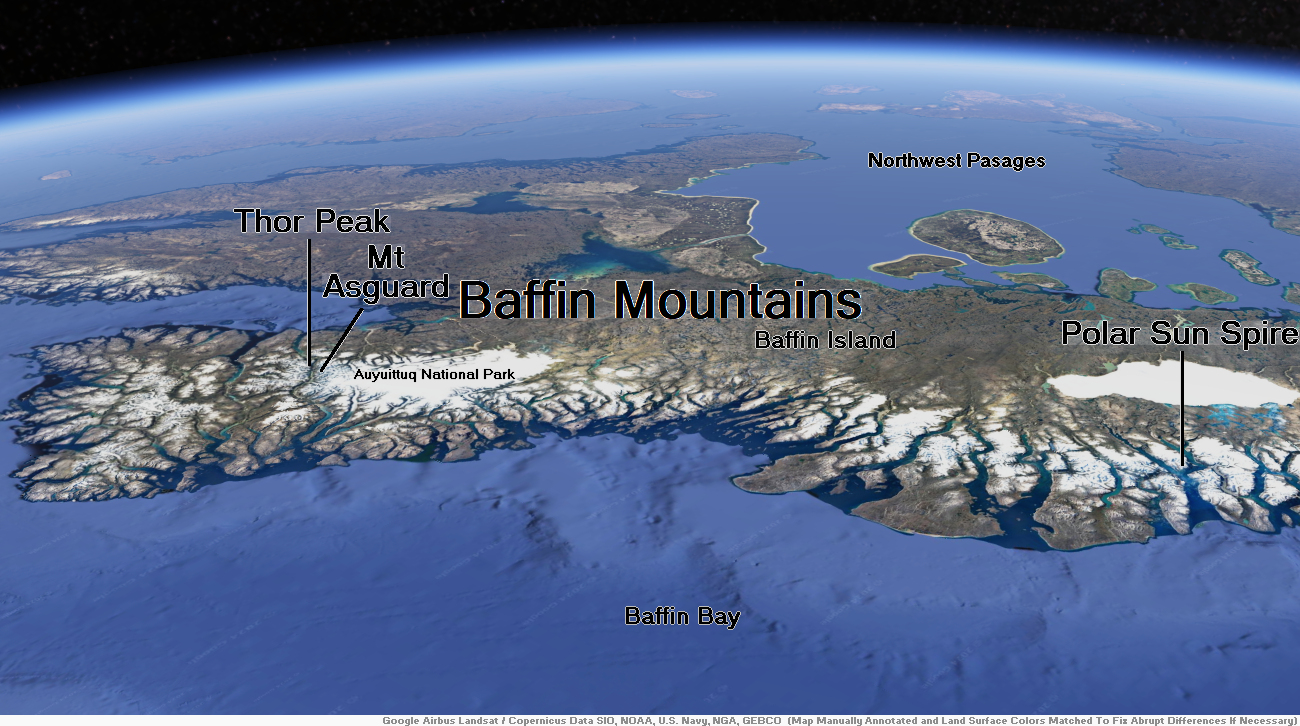
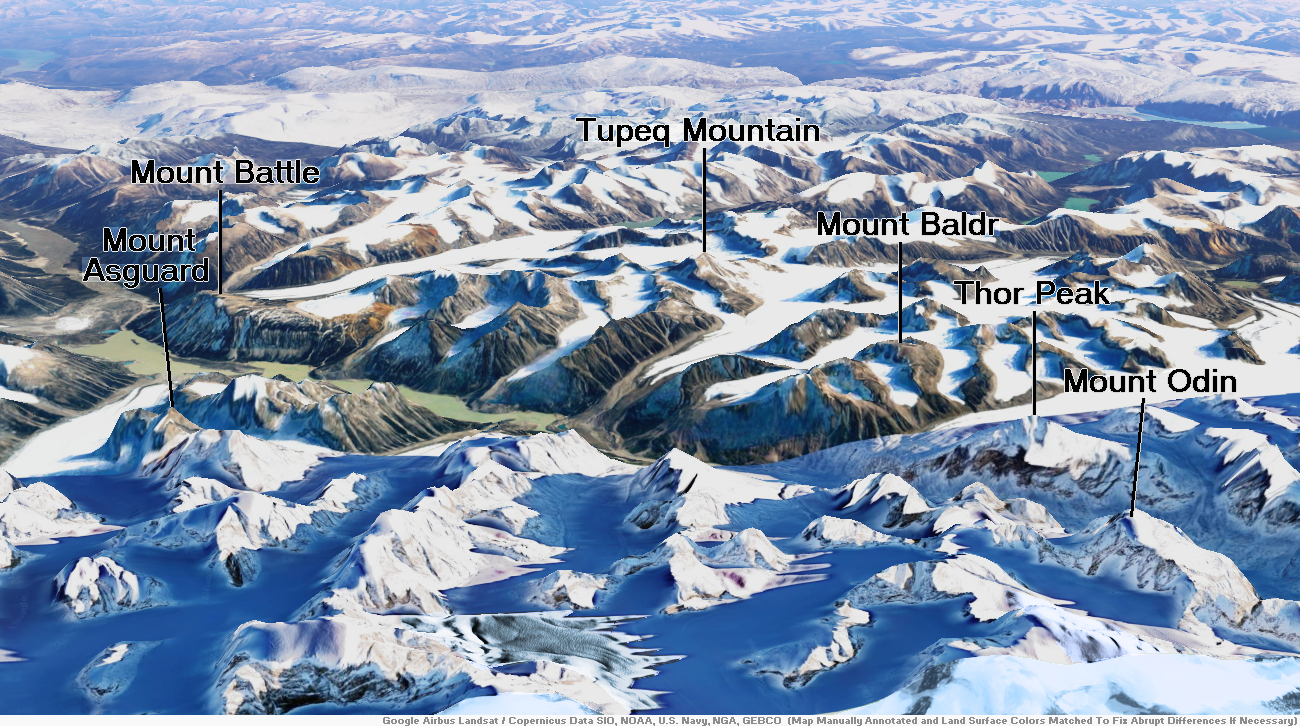
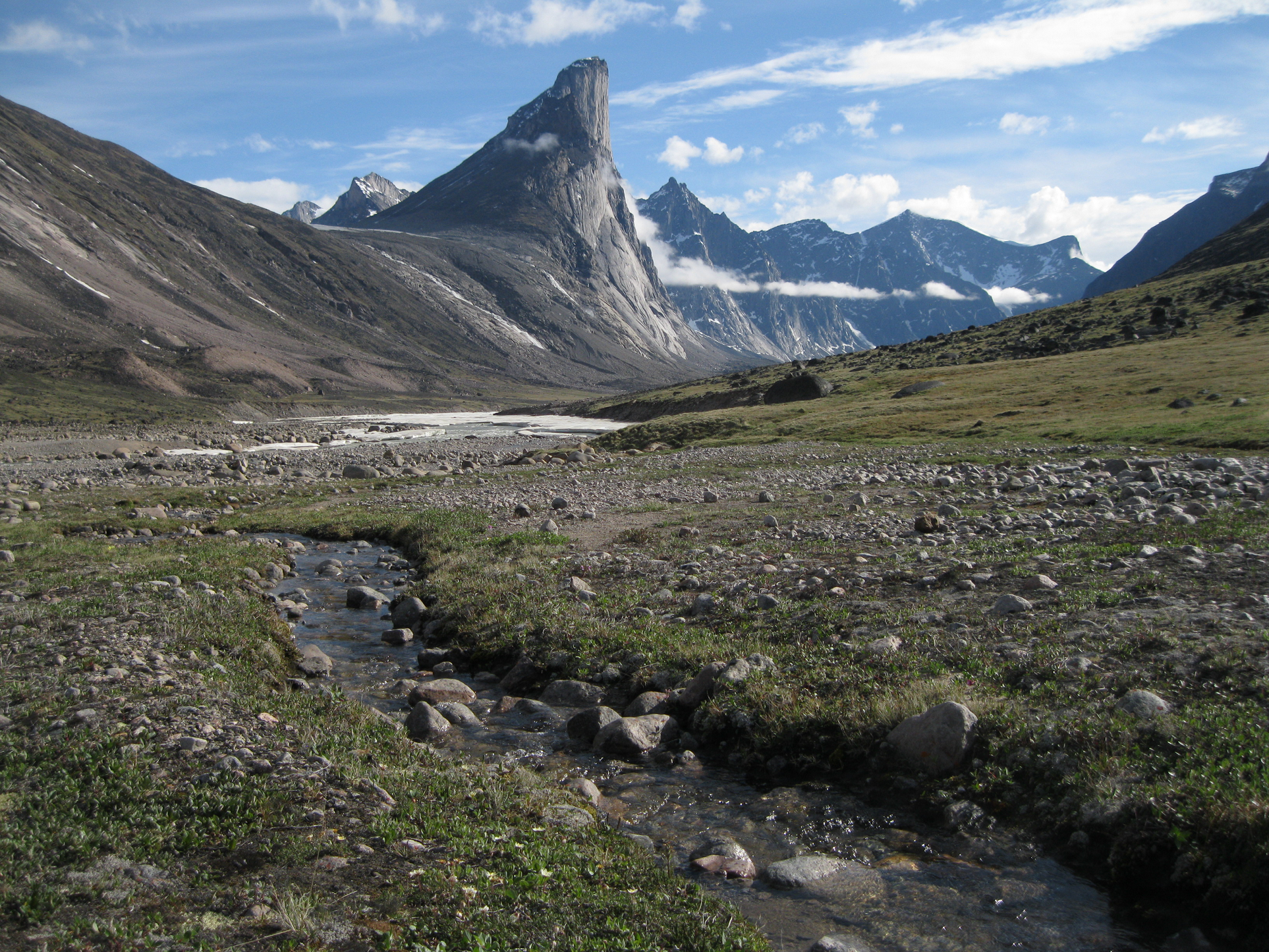
Thor Peak Region
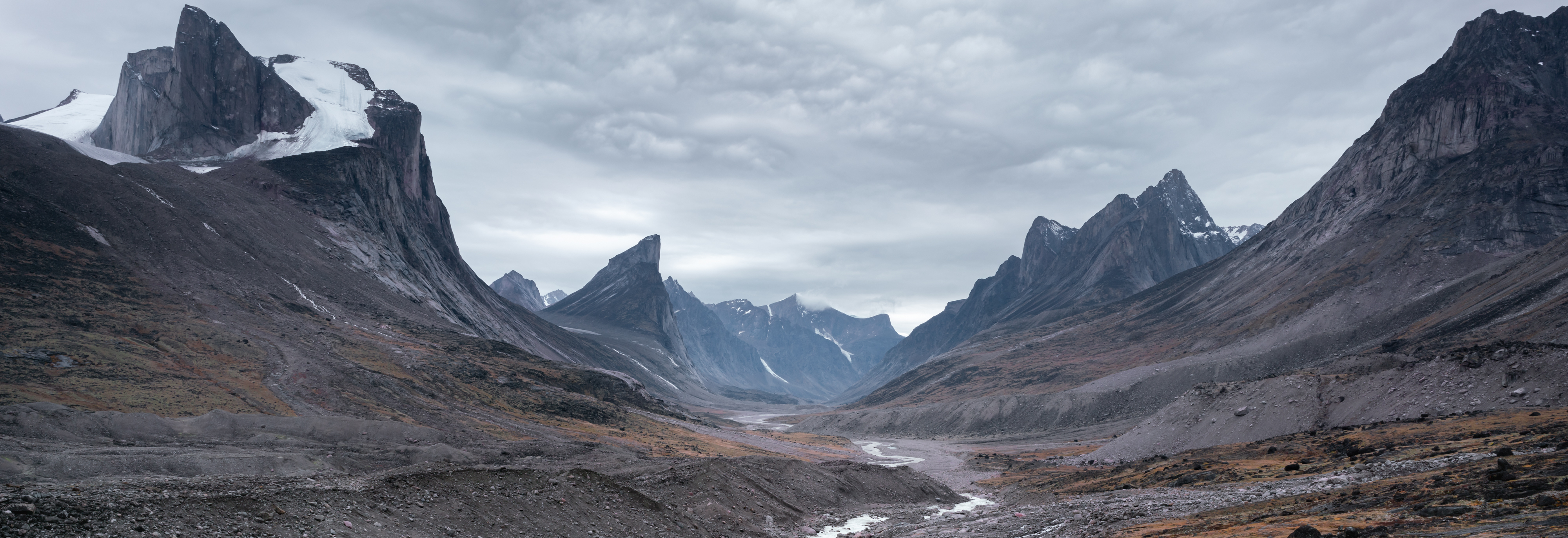
Thor Peak Panorama
Petr Kahanek (iStock)


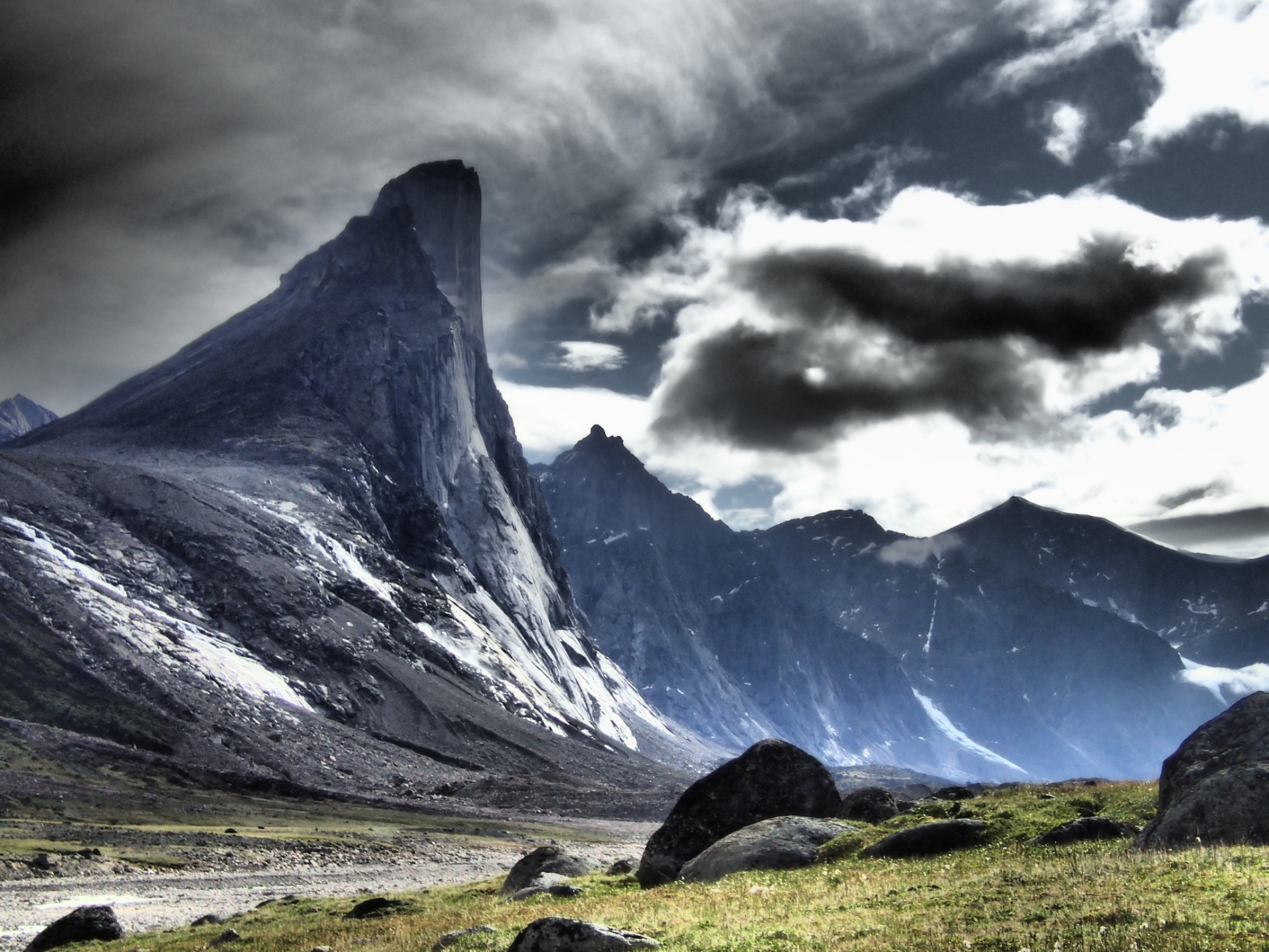
Mount Thor, officially gazetted as Thor Peak[2] (Inuktitut syllabics: ᙯᕐᓱᐊᓗᒃ, Inuktitut: Qaisualuk “huge bedrock”,[3][4] or Kigutinnguaq “tooth-like”[3][5]), in Nunavut, Canada, is a mountain with an elevation of 1,675 m (5,495 ft) located in Auyuittuq National Park, on Baffin Island. The mountain is located 46 km (29 mi) northeast of Pangnirtung and features Earth’s greatest vertical drop of 1,200 m (4,100 ft), with the cliff overhanging at an average angle of 105 degrees (15 degrees from vertical).[6] Despite its remoteness, this feature makes the mountain a popular rock climbing site. Camping is allowed, with several designated campsites located throughout the length of Akshayuk Pass. For climbers looking to scale Mount Thor, there is an established campsite a few kilometres north of its base, complete with windbreaks and emergency shelters.
The English naming of the mountain originates from Thor, the Norse thunder god.[7]
Geography
Mount Thor is part of the Baffin Mountains which in turn form part of the Arctic Cordillera mountain range.[1]
Geology
This mountain consists of solid granite. The rock making up this formation have been metamorphosed multiple times through earth’s history, causing this granitic layer to be pushed through other layers. The age of the rock ranges from 570 million years to 3.5 billion years (Precambrian), making it some of the oldest rock on earth. [8]
The peak and vertical drop itself are a product of glacial erosion, carved over millennia by seasonal glacial activity through the Akshayuk Pass, on the rim of which this mountain sits. Like other glacial channels, this pass has the characteristic U-shape which gives the mountain its vertical drop[9]
This article uses material from the Wikipedia article Mount Thor, which is released under the Creative Commons Attribution-Share-Alike 4.0 International License (view authors).
 |  |


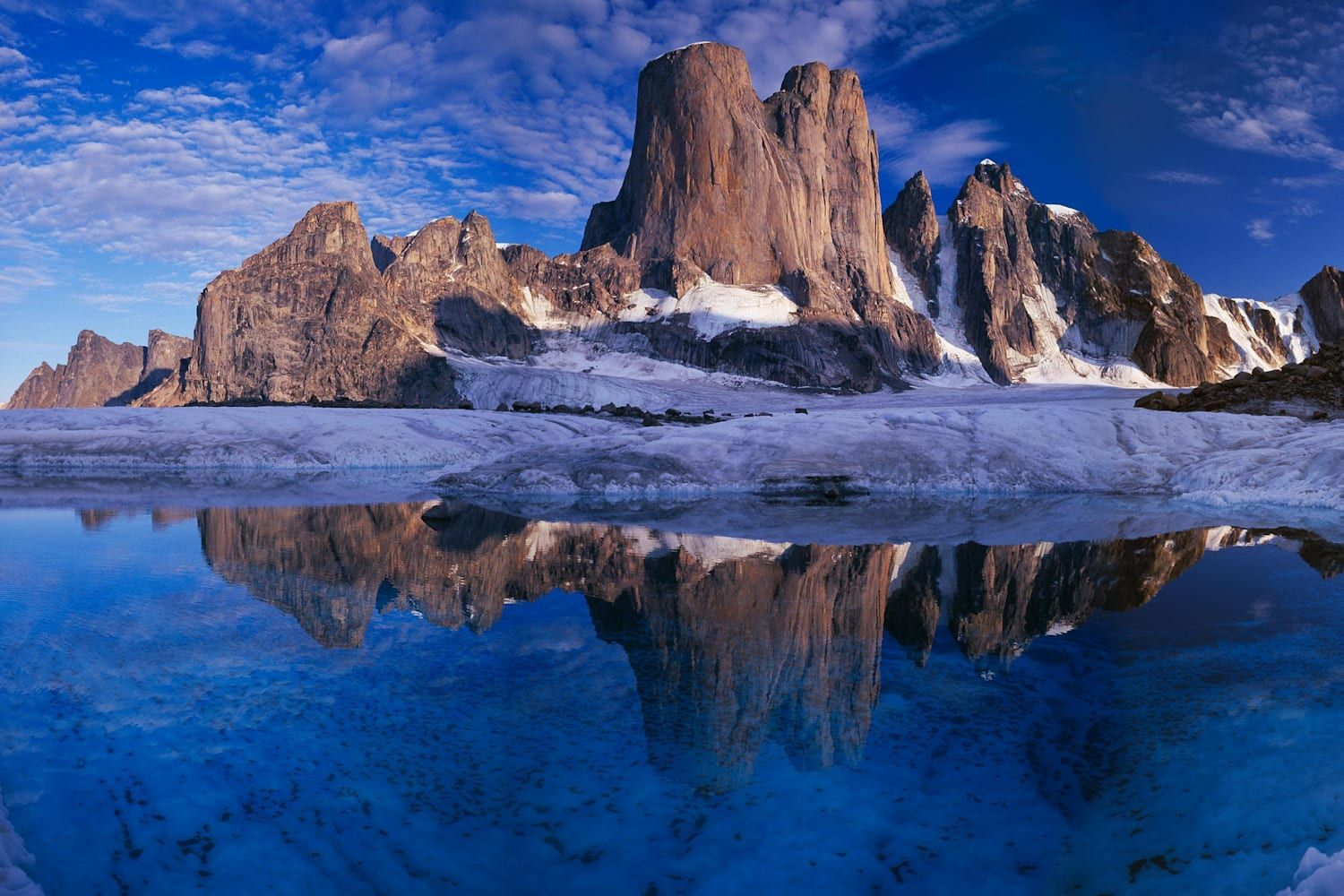
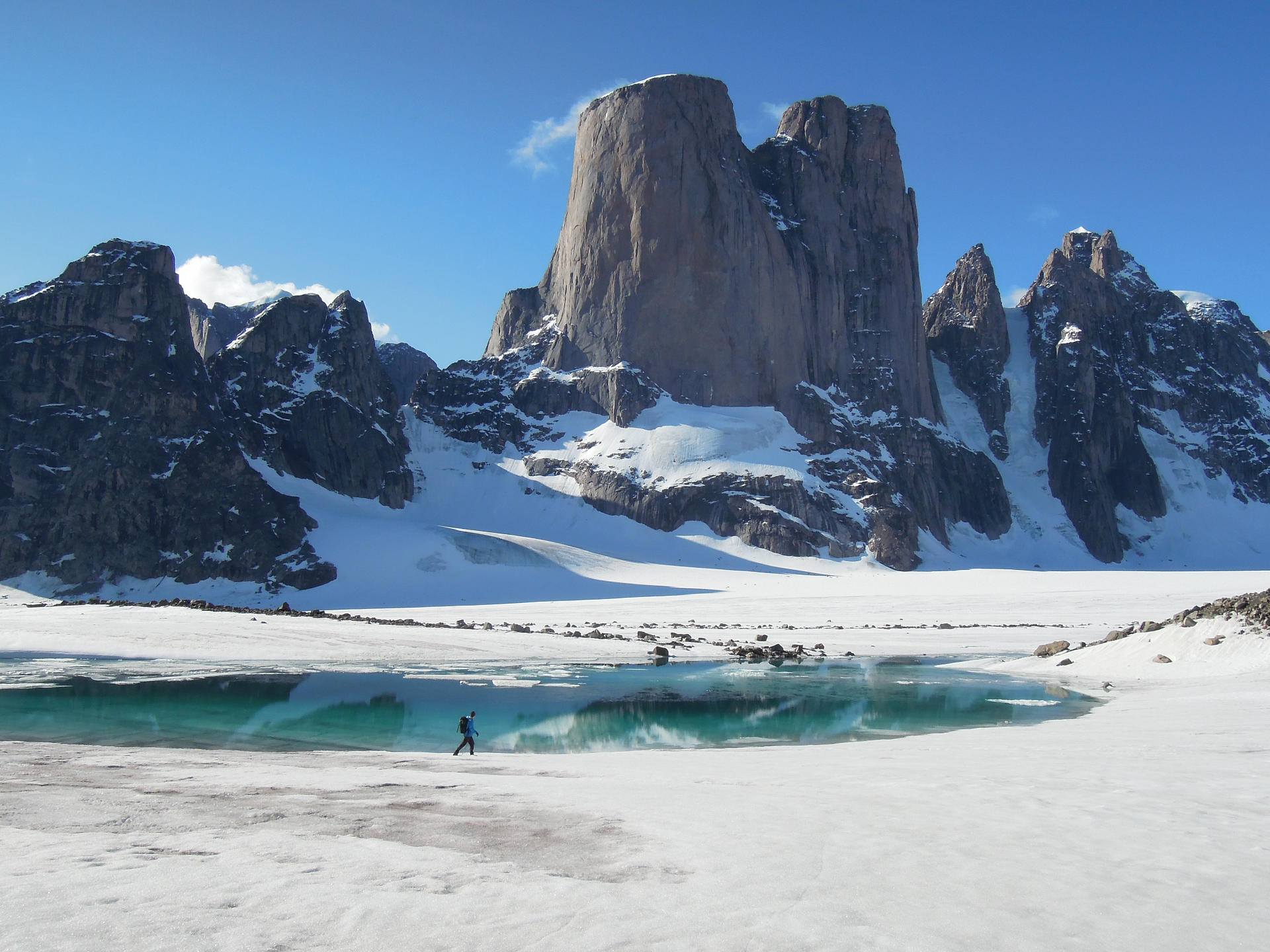
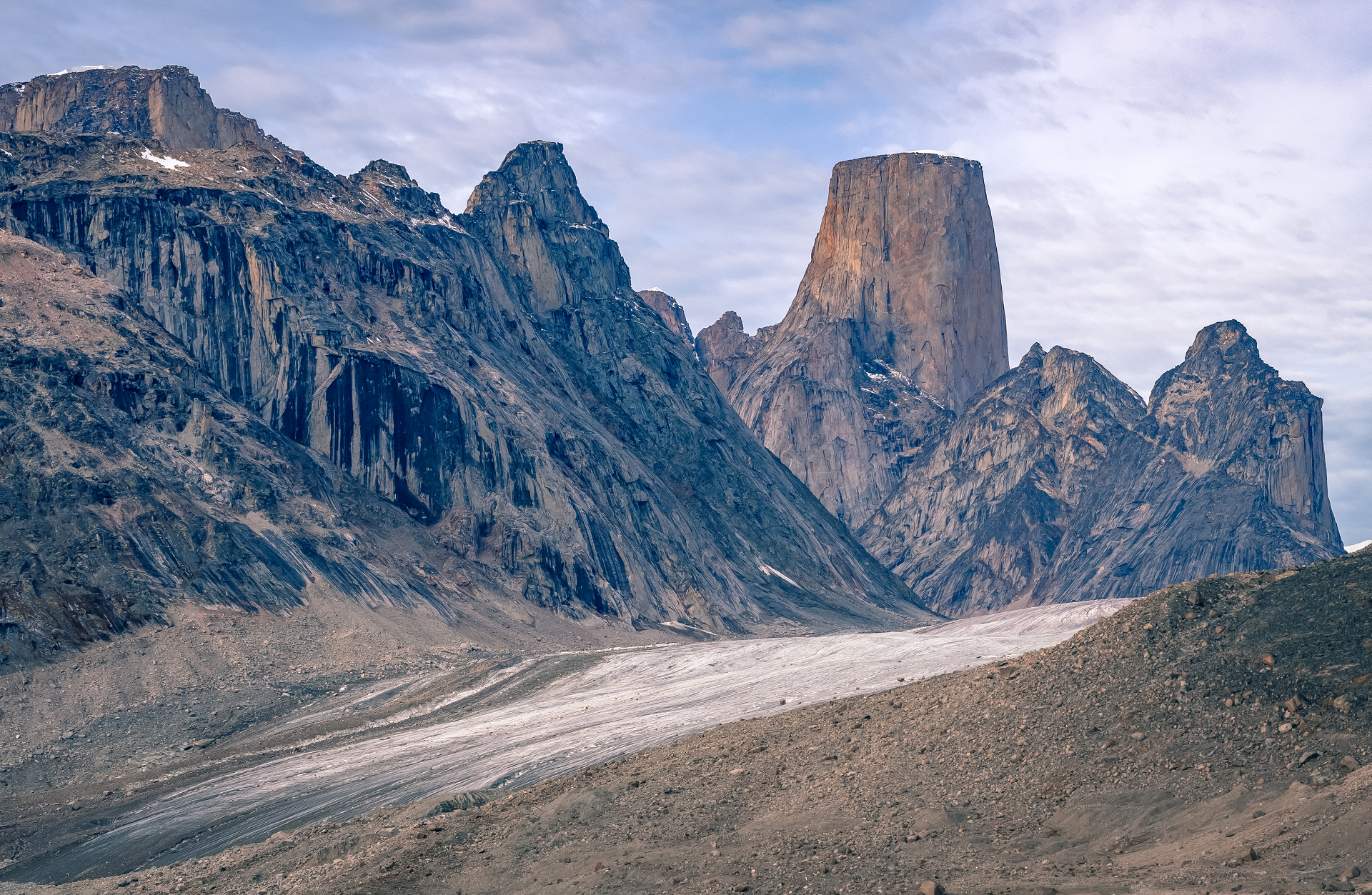
Mount Asgard (Inuktitut: ᓯᕙᓂᑎᕈᑎᖑᐊᒃ, Sivanitirutinguak[2][3][4]) is a twin peaked mountain with two flat-topped, cylindrical, rock towers, separated by a saddle. It is located in Auyuittuq National Park, on the Cumberland Peninsula of Baffin Island, Nunavut, Canada. The peak is named after Asgard, the realm of the Æsir (gods) in Norse mythology. Mount Asgard is perhaps the most famous of the Baffin Mountains.[5]
Climbing history
Asgard’s slightly higher North Peak was first ascended in 1953 by J. Weber, J. Marmet, and Hans Röthlisberger, Swiss scientists on the Baffin Island Expedition of the Arctic Institute of North America, led by the Canadian, P. Baird.[6] Their route ascended the east side of the north peak, using a climbing traverse across snowfields and rock ribs, to reach the saddle between the two peaks, and thence to the top of the North Peak. The route is graded VI, 5.8/5.9 A1. It is still the most-travelled route and is the standard descent route for climbers making more difficult ascents on other faces.[7]
The South Peak was first climbed in 1971 by G. Lee, R. Wood, P. Clanky, J. Pavur, Y. Kamisawa and P. Koch. Since then, at least 13 routes have been put up on the two peaks, most involving highly technical free and aid climbing, with lengths varying from 800 to 1,200 m (2,600 to 3,900 ft). One of the most notable routes was put up in 1975 by Charlie Porter as a solo climb. This was “the first Baffin modern, multi-day, technical, big-wall climb”, with 40 pitches rated at Grade VII, 5.10, A4 and it was followed by “a 10-day walk-out to the fjord-head without food”. The fact that this was all done solo was “a remarkable achievement”.[7]
In 2009, climbers and BASE jumpers Leo Houlding, Sean Leary and Carlos Quiroga Suarez participated in the Asgard Project, an attempt to make the first free ascent on the north tower of Mount Asgard. The film of their successful climb and descent, also called The Asgard Project, was critically acclaimed, winning 22 international film festival awards. After the film’s release, Parks Canada charged all three climbers for trespassing and illegally BASE jumping within Auyuittuq National Park.[8]
The charges were later dropped after the climbers paid donations to an environmental charity and made a public apology for their climb.[9]
This article uses material from the Wikipedia article Mount Asgard, which is released under the Creative Commons Attribution-Share-Alike 4.0 International License (view authors).
 |  |
 Petr Kahanek (iStock) | 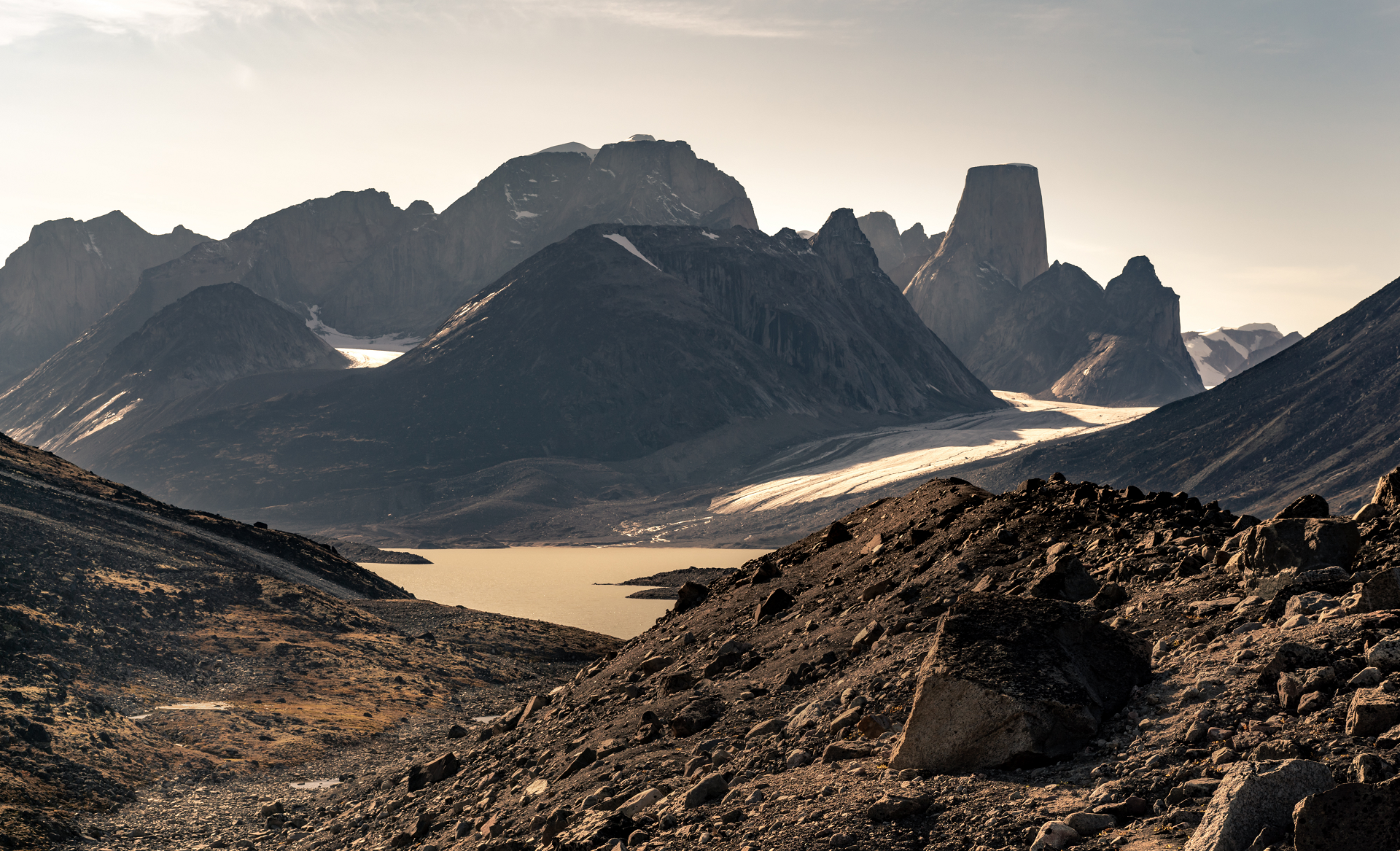 Petr Kahanek (iStock) |


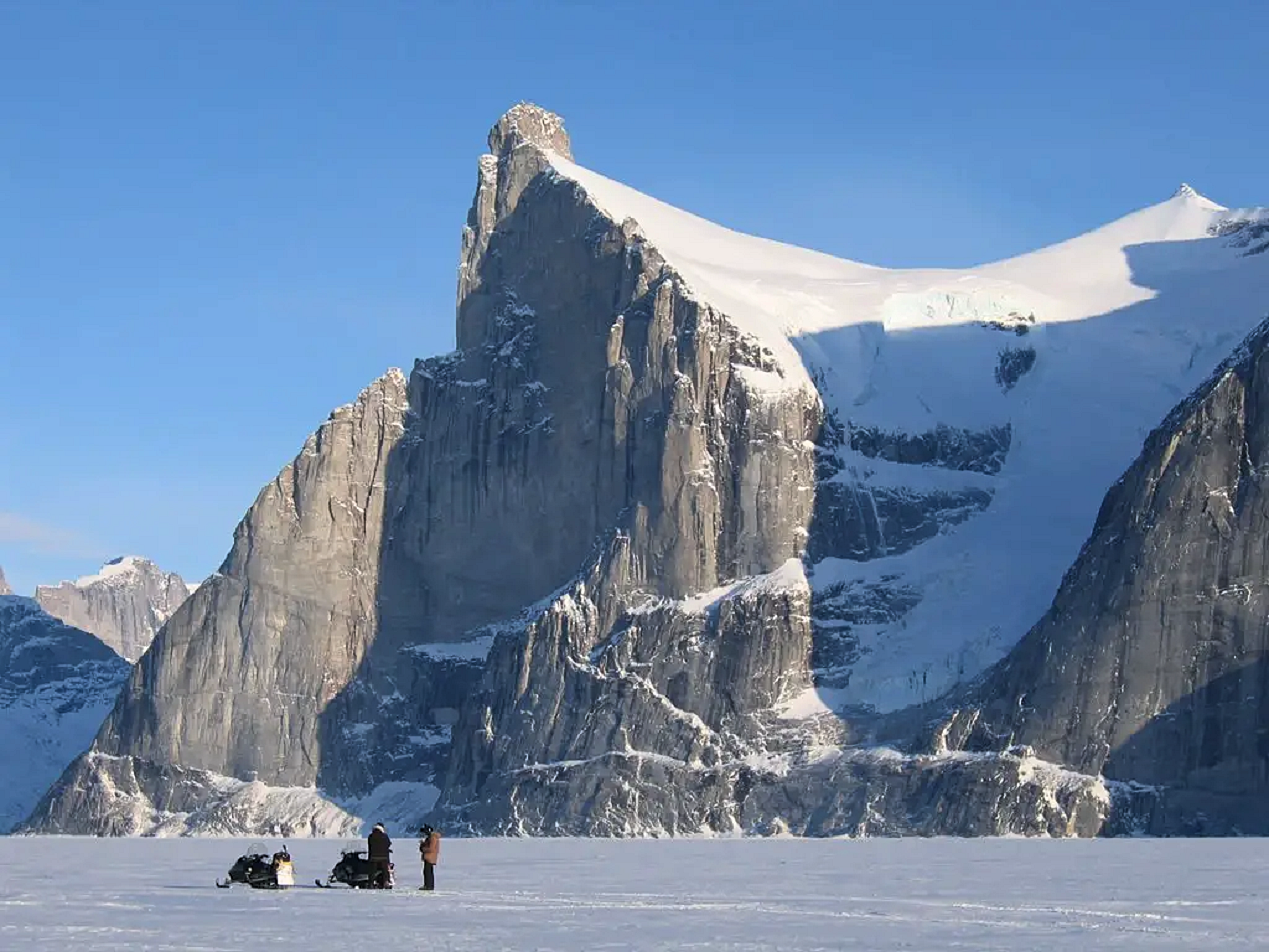
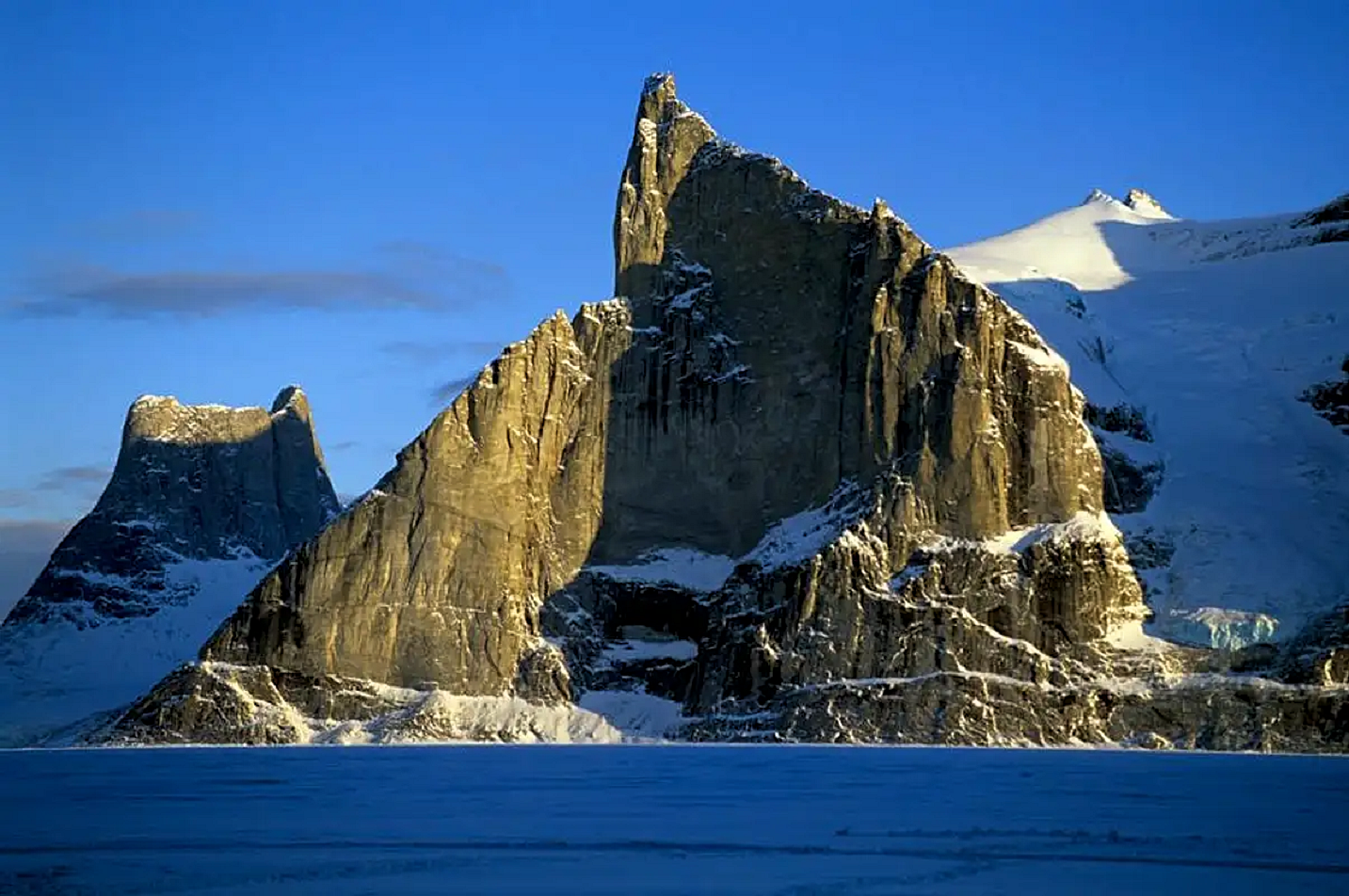
Polar Sun Spire is a peak in Beluga Mountain in the Sam Ford Fjord of Baffin Island, Canada.[1] The spire is notable for its spectacular 1,300 m (4,300 ft) north face. The first ascent was made in 1996 by Mark Synnott, Jeff Chapman and Warren Hollinger. The team spent a full month on the climb and summited after 36 consecutive nights in a portaledge. They encountered difficulties up to A4 and named their 34-pitch route “The Great and Secret Show.” A Norwegian team established another line in 2000.[2]
This article uses material from the Wikipedia article Polar Sun Spire, which is released under the Creative Commons Attribution-Share-Alike 4.0 International License (view authors).
 |  |
